Drum Filling Guide: How Full to Fill a 55-Gallon Drum (DOT Rules)

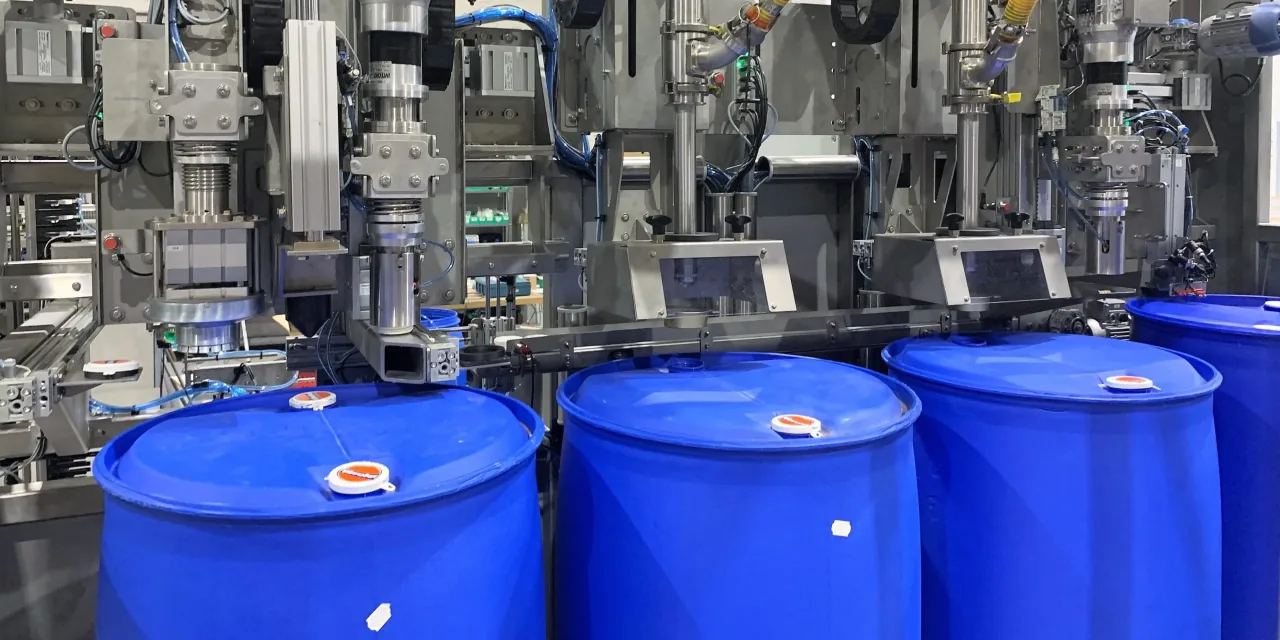
Filling a drum looks simple: open the bung, fill to the line, close it. Most problems show up later. Liquid filled on a cool morning expands in a hot trailer, pressure builds, and the drum bulges, weeps at the bung or splits a seam. Here’s how much room to leave, how to work it out for your product, and what DOT requires.
What Is Headspace in a Drum?
Headspace, also called outage or ullage, is the empty space left above the liquid: the amount by which a container falls short of being liquid full, usually expressed as a percent of its volume.
How many gallons are in a 55-gallon drum? 55 gallons is the nominal size. Brimful (overflow) capacity is about 57.2 gallons (216.5 L), so filling to 55 gallons leaves about 2.2 gallons of headspace.
Why Liquids Need Room to Expand
Most liquids grow as they warm. A drum filled at 68 °F (20 °C) can reach 131 °F (55 °C) in a closed trailer or a sunny yard in summer. How much the liquid grows over that 35 °C rise depends on what it is:
The difference matters. 55 gallons of water fits comfortably in a 55-gallon drum. 55 gallons of acetone or methanol filled at room temperature would be liquid full before reaching 131 °F. Solvents need more headspace than water.
How to estimate your fill limit
Methanol filled at 68 °F (20 °C): 57.2 ÷ (1 + 0.00149 × 35) = 54.37 gallons. At that fill the drum is liquid full at 131 °F, so fill below it and leave a margin for hotter conditions and measurement error. Cold product leaves less room: filled at 41 °F (5 °C), the rise to 131 °F is 50 °C, and the brim point drops to about 53.2 gallons.
What DOT Requires When Filling Drums
If the liquid is a hazardous material, the Hazardous Materials Regulations (49 CFR) set the limits:
- Leave enough outage. Enough ullage must be left that expansion at temperatures likely during transport causes neither leakage nor permanent distortion of the drum (49 CFR 173.24(h)(1)).
- Not liquid full at 131 °F. In non-bulk packagings such as drums, liquids must not completely fill the receptacle at 55 °C (131 °F) or less (49 CFR 173.24a(d)).
- Stay within the marked specific gravity. A drum marked 1A1/Y1.8 is rated for liquids up to specific gravity 1.8 in Packing Groups II and III. If none is marked, the limit is 1.2 (49 CFR 173.24a(b)(1)). The drum must also be compatible with your product.
- Respect any marked gross mass, and for volatile liquids, check vapor pressure against the drum’s marked test pressure (49 CFR 173.24a(b)(2) and (b)(4)). On a liquid drum mark such as 1A1/Y1.8/300, the last number is the test pressure in kPa, not a weight.
- Leave nothing on the outside. No hazardous material residue may remain on the outside of the package (49 CFR 173.24(b)(4)).
IBC totes have their own rule: no more than 98% of water capacity at a mean bulk temperature of 122 °F (50 °C) (49 CFR 173.35(d)). See IBC tote dimensions for tote sizes.
Non-hazardous products aren’t covered by these rules, but the physics is the same. An overfilled drum of syrup or cleaner bulges and leaks just like a solvent.
Check the Weight, Too
A dense liquid can hit the drum’s weight limit before it hits the volume limit. 55 gallons of a liquid with specific gravity 1.8 is 55 × 8.34 × 1.8 = about 826 lb of product before the drum. Check that against the weight rating on the drum’s spec sheet (and any maximum gross mass marked), and against your forklift and drum handler.
Steel vs. Plastic Drums When Filling
If you fill product hot, ask your supplier about the drum’s temperature limit and how to avoid paneling as it cools.
Why Do Drums Bulge? Causes and Fixes
A bulging drum is under pressure from the inside. The usual causes:
- Overfilling. Too little headspace, so the expanding liquid pushes on the heads.
- Heat. Sun, a hot trailer or a warm warehouse raises vapor pressure, especially with solvents.
- Product that gives off gas. Some chemicals, fermenting food products and contaminated waste build gas over time.
- The wrong drum. A drum rated below the product’s specific gravity or vapor pressure.
What to do: keep people clear and don’t open the bung while the drum is bulged. If it’s safe to move, take it somewhere cool and shaded. Vent it only as your SDS and site procedures allow, with the right PPE. A drum that stays deformed after cooling shouldn’t be reused for hazardous materials. To prevent bulging, fill to the limit above, store out of direct sun and match the drum’s rating to the product.
A Simple Drum Filling Checklist
- Confirm the drum’s UN mark covers your product’s packing group and specific gravity, and that the drum is compatible with the product.
- Measure the product temperature at filling.
- Work out the brim point with the formula above and fill below it. Leave extra room for cold product and summer shipping.
- Fill by weight on a scale where you can: target weight = gallons × 8.34 × specific gravity.
- Close bungs or the lid following the manufacturer’s closure instructions, including torque where specified, and wipe the outside clean.
- Record fill temperature and volume on the batch record.
How Novvia Helps
Novvia’s companies supply new and reconditioned steel and plastic drums, including UN-rated drums for hazardous liquids, with steel drums from Rahway Steel Drum. Share your product’s SDS, fill temperature and any technical data you have, and a packaging specialist will help you evaluate drum options and filling requirements.
Frequently Asked Questions
How full should a 55-gallon drum be?
Full enough that the liquid can’t fill the drum completely at 131 °F (55 °C). Water filled at room temperature fits at 55 gallons. Solvents need more room: filled at room temperature, most need to stay below about 54.3 to 55 gallons.
How much headspace is in a 55-gallon drum?
About 2.2 gallons when filled to 55 gallons, in a typical drum that holds about 57.2 gallons brimful.
What does DOT require for filling drums?
For hazardous liquids, the drum must not be liquid full at 131 °F or below, the liquid must stay within the drum’s marked specific gravity (and any marked gross mass), and nothing can be left on the outside.
What is outage or ullage?
The empty space left above the liquid. Both words mean the same as headspace.
Do non-hazardous liquids need headspace?
Yes. DOT rules don’t apply, but liquid expansion is the same, so an overfilled drum can still bulge or leak.