How to Choose Plastic Bottles With Caps That Seal Reliably

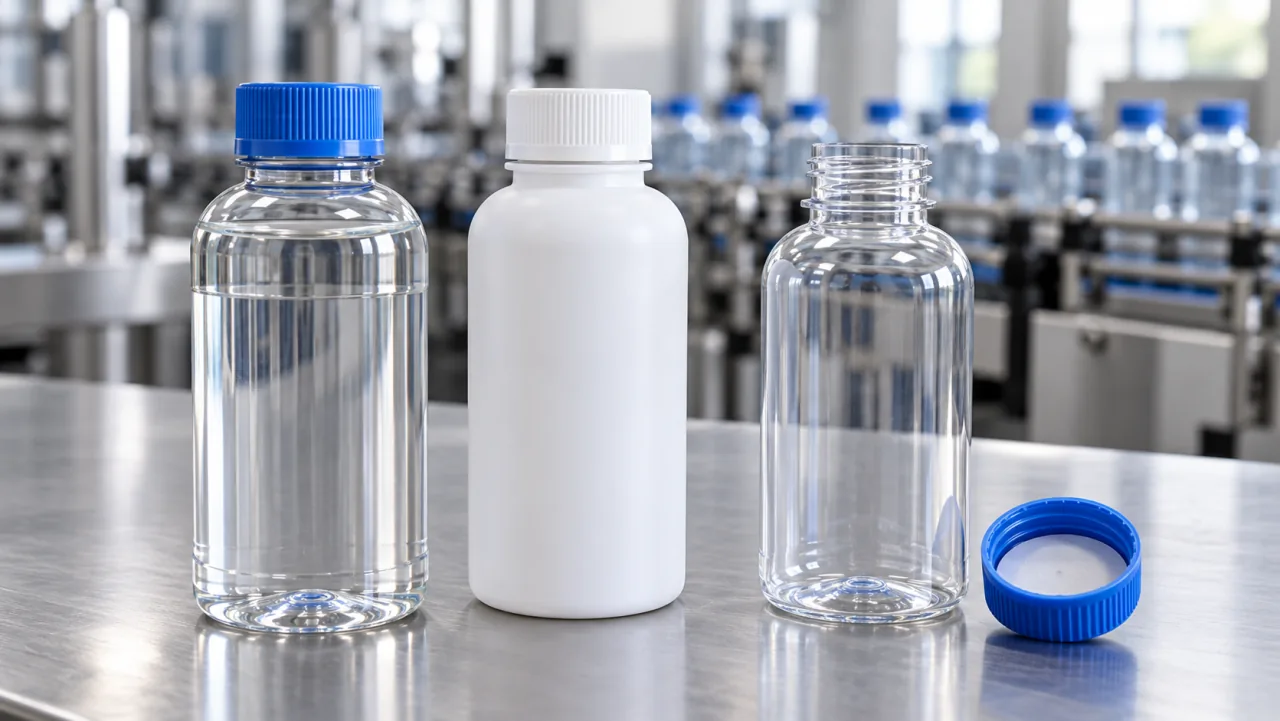
A cap threads onto a bottle smoothly. The filled sample looks right.
That is a useful first check, but it is not enough to approve the package.
Neck-finish dimensions affect engagement. Product-contact materials need to suit the formulation. For induction-sealed packages, liner compatibility and cap application torque affect whether a consistent seal forms.
When sourcing plastic bottles with caps, evaluate the complete assembly rather than approving each component independently.
Start With the Product and Filling Process
Before choosing a bottle shape or closure style, prepare a clear application brief.
Include:
- The formulation and relevant chemical characteristics.
- Bottle capacity and target fill volume.
- Filling temperature and process.
- Required dispensing method.
- Expected storage and distribution conditions.
- Intended shelf life.
- Applicable regulatory requirements.
- Order quantities, delivery locations, and target production date.
Novvia’s packaging guidance similarly recommends starting with the formulation, matching the full assembly, and coordinating supply requirements before ordering.
This information gives suppliers a better basis for recommending components and identifying the testing your technical team needs to complete.
Match the Bottle Neck Finish to the Closure
Understand the Finish Designation
A designation such as 28-400 identifies a nominal neck size and finish series.
The first number relates to the diameter across the bottle’s external threads. The second identifies a finish series with defined characteristics, including thread configuration and finish height. Matching the nominal diameter alone does not establish compatibility.
Do not substitute a different finish series without confirmation from the component suppliers.
Review the Dimensions Behind the Code
C.L. Smith identifies five important neck-finish dimensions:
Thread depth is calculated as (T − E) / 2.
Request current bottle and closure specifications, including relevant drawings and tolerances. Use the finish code as a starting point, not the entire approval process.
Evaluate the Sealing Interface
A hand-applied cap does not verify performance under production conditions.
The assessment should address thread engagement and the dimensions relevant to the closure’s sealing design. For induction-sealed packages, it must also address contact between the innerseal and the bottle’s sealing surface.
Confirm Material Compatibility With the Actual Formulation
Resin selection is a screening step, not a complete compatibility assessment.
Supplier chemical-resistance guides can help narrow the options, but their ratings have stated limitations and apply to particular products and conditions. Thermo Fisher, for example, describes its chemical-resistance chart as a general guide specific to its Nalgene products.
Common bottle materials include HDPE, PET, PP, and PVC. Ocean State Packaging supplies stock and custom options across these materials, but suitability still needs to be established for the specific application.
Share enough formulation information for your supplier and technical team to assess the actual product-contact materials, not simply the broad category of “cleaner,” “personal care,” or “industrial chemical.”
Account for Environmental Stress Cracking
Polyethylene packaging can be susceptible to environmental stress cracking under certain combinations of material, stress, and chemical exposure.
BAM’s research on polyethylene containers examines this mechanism alongside interactions such as swelling and plasticization. Its test liquids include surfactants, emulsifiers, and some organic solvents relevant to crop-protection formulations.
This is one reason a short visual inspection cannot establish long-term compatibility.
Confirm Temperature Requirements
If the package will be hot-filled, steam-treated, or autoclaved, obtain confirmation for the specific bottle and closure assembly.
Some polypropylene products are designed for autoclaving, while other common plastic bottle products are not. Resin identity alone should not be treated as approval for a particular processing cycle.
Specify the Sealing Design
Do not leave the liner or sealing feature as an unspecified default.
Depending on the design, a closure may use a separate liner, an induction innerseal, or a linerless sealing feature. The dimensions and material requirements differ.
Ask your supplier to identify:
- The exact closure and liner references.
- Product-contact materials.
- The bottle materials the sealing layer is designed to work with.
- Relevant application and processing requirements.
- Whether a different liner or closure variant changes the package specification.
Check Induction-Liner Compatibility
For induction sealing, the liner’s sealing layer must be compatible with the container material.
An incompatible liner may fail to adhere even when more heat is applied. Enercon recommends selecting the liner with consideration of both the bottle material and the product being packaged.
The liner, bottle, closure, and sealing equipment therefore need to be evaluated together.
Define Cap Application and Sealing Settings
The correct components still need the correct application process.
For induction-sealed packages, cap application torque provides the downward pressure needed to hold the innerseal against the bottle’s sealing surface. Too little pressure can produce an inconsistent seal.
Obtain the recommended application requirements from your suppliers and verify them on your equipment.
Where applicable, document:
- Cap application torque.
- Capping-equipment setup.
- Induction-sealer settings.
- Line speed.
- Inspection and acceptance criteria.
Use trials with the actual component combination rather than assuming that settings from a previous bottle or closure will transfer unchanged.
Test Filled Packages Under Defined Conditions
Replace an informal “fill it and leave it somewhere warm” check with a documented evaluation plan.
The plan should reflect the formulation, product-contact materials, filling process, and intended storage and distribution environment. Formal compatibility testing may be necessary for some applications, particularly regulated dangerous-goods packaging.
Depending on the project, your technical team may include checks for:
- Leakage.
- Changes in the bottle, closure, or liner.
- Seal consistency.
- Opening and reclosing performance.
- Performance after relevant storage or distribution exposure.
Define the conditions, duration, and acceptance criteria before testing begins. A sample that looks acceptable after a short trial has not necessarily demonstrated the package’s intended shelf life.
Check Child-Resistant Packaging Requirements Separately
If the product requires child-resistant packaging, request documentation applicable to the proposed package configuration.
Under U.S. Poison Prevention Packaging Act requirements, special packaging must meet child-resistance and applicable adult-use testing requirements. It is not enough for a cap simply to feel difficult to open.
Do not assume documentation for one bottle-and-closure combination covers a different combination. CPSC recommends retesting and recertification when changes include a different closure-and-package combination, packaging material, manufacturing process, or packaged substance.
Requirements depend on the product and applicable jurisdiction. Confirm them before finalizing the package.
Compare Supply Requirements Before Approving the Package
Technical suitability and purchasing practicality are separate checks.
Confirm the commercial requirements for both the bottle and closure before placing either order.
Coordinating quantities, delivery locations, and timing is part of planning the complete package, alongside component selection and sample evaluation.
A closure that is technically suitable but unavailable for the fill date is not a complete sourcing solution.
What to Confirm With Your Supplier
These checks bring together the dimensional, sealing, compatibility, regulatory, and supply considerations discussed above.
How Novvia Helps You Source Bottles and Closures
Novvia Group companies offer bottle manufacturing, component sourcing, and packaging support across different applications.
- Ocean State Packaging supplies stock and custom plastic bottles, caps, and closures in PET, HDPE, PVC, and PP, with consultative sales and design and decoration support.
- Lyons Blow Molding, C.L. Smith’s manufacturing division, produces HDPE bottles and containers using stock and private molds. Its capabilities include different neck finishes, shapes, handles, colors, and smaller-run custom production.
- C.L. Smith combines packaging manufacturing, distribution, and custom design. Its HAZPlus division supports hazardous materials packaging applications.
- Liquid Bottles supplies bottles, jars, closures, and other rigid packaging through its online store, with fast shipping for in-stock products.
Bring your formulation, preferred format, dispensing requirements, quantities, and production timeline to the discussion. Ask which component combinations are available, what samples can be supplied, and which technical checks remain your responsibility.
Before You Place the Order
Approve the complete package before committing to production quantities.
Confirm the bottle-and-closure fit, product-contact materials, sealing design, and application requirements. Evaluate filled samples under defined conditions, then align availability and delivery timing for both components.
To discuss packaging options and prepare a project-specific quote, speak with a Novvia packaging expert.
Frequently Asked Questions
What does 28-400 mean on a plastic bottle?
It identifies a nominal neck size and finish series. The first number relates to the diameter across the external threads, while the second identifies the finish configuration. Confirm compatibility using the relevant bottle and closure specifications.
Can I use a 410 cap on a 400 bottle?
Do not assume they are interchangeable. Matching nominal diameters does not establish matching finish geometry or sealing performance. Obtain supplier confirmation before substituting a different finish series.
How do I know whether a bottle is compatible with my product?
Start with supplier material guidance, then evaluate the actual formulation and complete package under defined conditions. General chemical-resistance charts are screening tools, not a substitute for application-specific assessment.
Does a cap that fits by hand prove the package will seal?
No. Fit is only one part of the assessment. For induction-sealed packages, liner compatibility and application torque also affect seal formation.
Do all caps need a separate liner?
No. Some closures use linerless sealing features. Specify the actual sealing design and verify that the bottle dimensions support it.
Does an induction liner work with any plastic bottle?
No. The sealing layer must be compatible with the container material, and the application and induction-sealing process must be appropriate for the assembly.
Can I move a child-resistant cap to a different bottle?
Do not assume the existing documentation covers the new combination. CPSC recommends retesting and recertification when a different closure-and-package combination is used.
Should bottles and closures have matching order quantities?
Not necessarily, but both quantities need to fit your purchasing and production plan. Confirm the exact component references, quantities, availability, and delivery timing together.