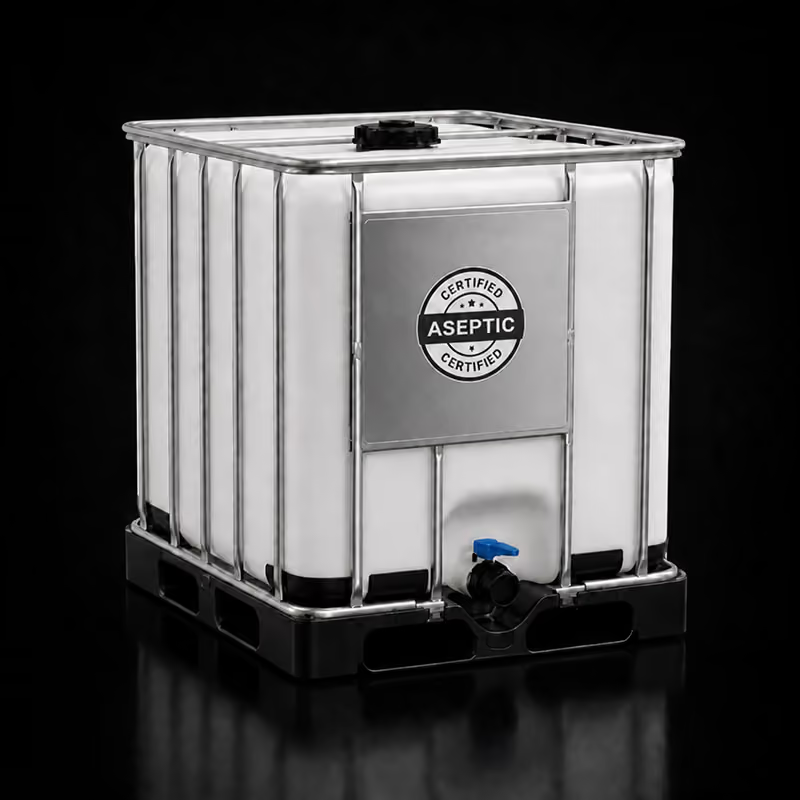
Aseptic IBC containers use a replaceable product-contact liner to reduce contamination exposure for sensitive liquid ingredients. Concentrates, purees, and syrups fill into a fresh liner every time, simplifying changeover between products.
Liner-based IBC systems for concentrates, purees, and syrups where each fill needs a fresh product-contact surface. The liner does the sealing work and the outer container does the carrying, with collapsible options that reduce return-shipping space.
New HDPE inner receptacle molded from FDA-compliant, food-grade resin.
Valve and cap options selected for clean discharge and simple sanitation.
Sealed fill caps and discharge covers help protect product integrity in transit.
Both capacities share a standard pallet footprint for consistent handling.
Bulk Liquid Ingredients
Edible Oils & Syrups
Industrial Chemicals
Acids & Caustics
Cleaning Products
Water Treatment Chemicals
Process Water & Wastewater
Oils & Lubricants
Hazardous Liquids
Specify a new or newly rebottled HDPE bottle; reconditioned bottles are not assumed food grade.
Confirm FDA-compliant, food-grade resin and request documentation for your ingredient.
Match the valve and cap to your fill line and cleaning procedure before ordering.
Choose 275 for dense product or height limits, 330 to maximize volume per pallet.
An IBC tote, or intermediate bulk container, is a palletized industrial container used to store, transport, and dispense bulk liquids, pastes, powders, or granular materials. The common composite version is an HDPE bottle inside a galvanized steel cage on an integrated pallet base.
No. A tote should only be used for food or beverage products when its materials, manufacturing history, and condition are appropriate for that application. Reconditioned or previously used totes should not be assumed to be food grade.
A new IBC tote uses a new bottle, cage, and pallet. A rebottled IBC generally combines a new inner bottle with a reused and inspected cage. A reconditioned IBC generally uses a previously used bottle and cage that have been cleaned and inspected.
The most common rigid composite IBC tote capacities are 275 gallons and 330 gallons. Both generally use a comparable pallet footprint, so the practical difference is overall height, filled weight, and volume per pallet position.
Common options include ball valves, butterfly valves, camlock connections, and threaded outlets. The correct valve depends on product viscosity, flow requirements, chemical compatibility, and facility connections.