
What Is Corrugated Fiberboard? Details Bulk Buyers Miss

Choosing corrugated fiberboard starts with understanding what your shipment needs, not simply selecting a thicker board. When you’re buying thousands of cases, that decision affects material costs, storage space, and product protection.
This guide explains what corrugated fiberboard is and what to look for when buying it at scale. You’ll learn how to compare supplier quotes and specify packaging that fits your product, packing line, and distribution route.
1. What Is Corrugated Fiberboard Made Of?
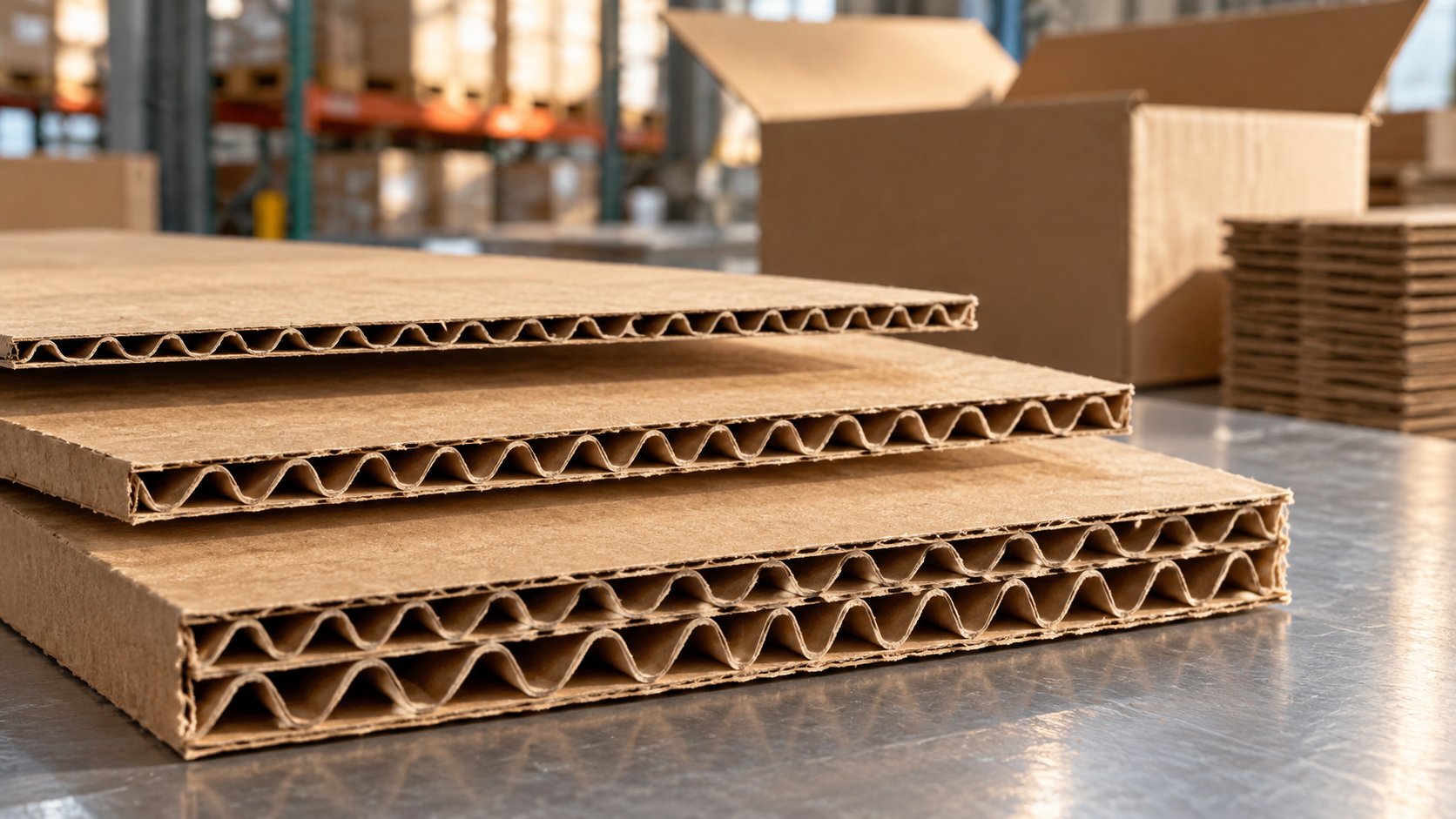
Look at a cut edge: the flat sheets are linerboard, and the wavy paper between them is the fluted medium. Together they create a lightweight structure used in shipping cases, trays, partitions, and other packaging.
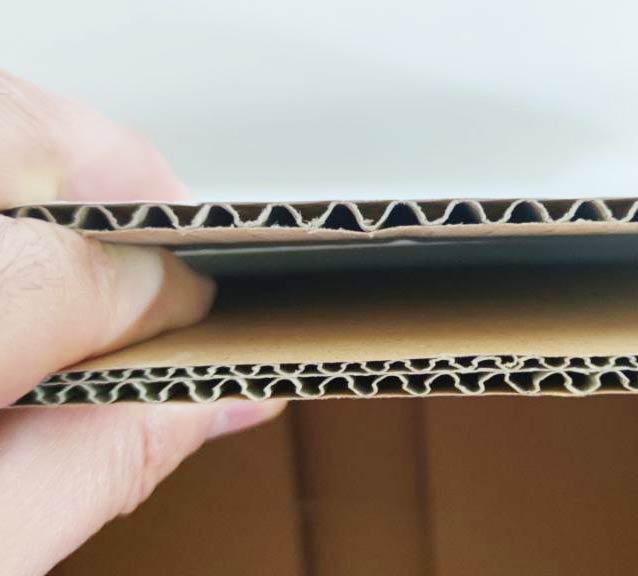
“Cardboard” may be a familiar term, but it leaves too much open to interpretation when you’re placing an order. The Fibre Box Association’s guide to corrugated construction explains the distinction: corrugated fiberboard combines flat liners with a fluted paper layer, giving the material its characteristic structure and strength.
For a clearer purchasing specification, describe the board construction, the performance you need, and the finished packaging component. A layer pad, partition, and shipping case serve different purposes. Your specification should make clear what you’re buying and what it needs to do.
2. What Does the Flute Profile Tell You?
A flute letter tells you about the board’s profile, not its overall strength. That profile affects thickness, cushioning, and the printing surface, but it’s only part of the specification. When ordering, pair the flute profile with clear performance requirements.
| Flute profile | General characteristic | Buyer consideration | Profile illustration |
|---|---|---|---|
| A | Larger profile | Review cushioning and total package thickness. | 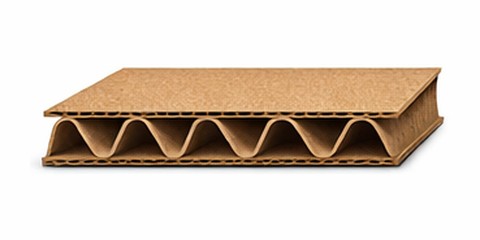 |
| B | Smaller profile than A | Assess the balance of thickness and protection. | 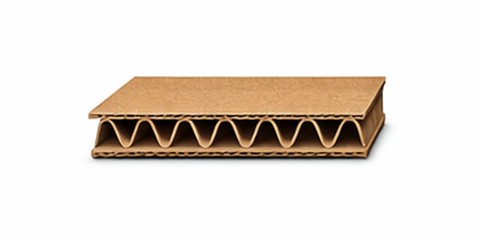 |
| C | Common general-purpose profile | Validate the specified board in the finished case. | 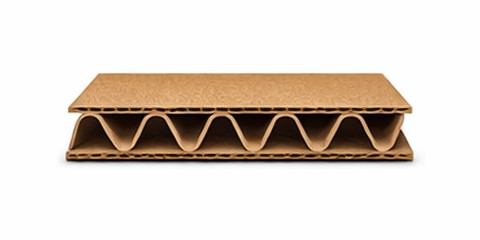 |
| E / F | Fine flute profiles | Review print presentation and required protection. | 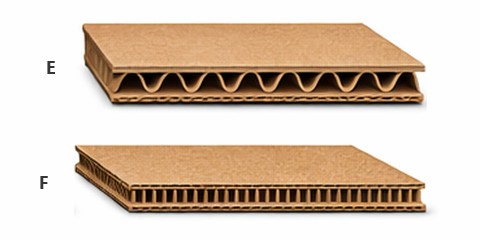 |
Be sure to ask for the supplier’s actual board specification and representative samples. Two boards with the same flute designation can still differ in their paper components and finished performance.
3. Does Your Product Need Single or Double Wall?
An extra layer of corrugated board isn’t automatically the right solution. The choice depends on what’s inside the package, how it’s packed, and the conditions it faces during shipping.
- Single-face board has one liner bonded to one fluted medium.
- Single-wall board has one fluted medium between two liners.
- Double-wall board has two fluted mediums and three liners.
Evaluate the package as a whole. A fragile product that relies on inserts for protection has different needs than rigid containers that help support the case. Consider the contents, internal protection, box dimensions, and pallet arrangement together rather than choosing by wall construction alone.
The goal is enough protection without unnecessary material. Before upgrading to double wall across every SKU, ask your supplier which measurable requirement the change addresses and whether each product needs it.
4. ECT and Burst Strength Measure Different Things
A strength rating is only useful when you know what it measures. ECT and burst strength describe different properties of corrugated board, so they should not be treated as interchangeable specifications.
An edge crush test (ECT) measures how well a board sample resists compression along its edge. TAPPI T 811 describes one method for measuring this property. The result characterizes the board, not the maximum load a finished box can carry.
Burst strength measures the pressure required to rupture the board. TAPPI T 810 describes this test for single-wall and double-wall corrugated board. It measures a different type of resistance than ECT.
For the finished package, ask your packaging team which tests reflect the conditions it will face. Agree on the test conditions and acceptance criteria before comparing options.
A rating printed on a case is a starting point, not a complete answer to stacking performance. Review it alongside the box dimensions, construction, contents, pallet support, and shipping and storage conditions.
5. Have You Specified the Finished Box Correctly?
The right board won’t solve the wrong fit. A small dimensional mismatch can leave a divider too tight, a container poorly positioned, or a case struggling to move through the packing line. Make sure suppliers are quoting the same finished package, not just similar dimensions.
- State whether dimensions are internal or external, along with the units and measurement sequence.
- Specify the box style, joint, closure method, and acceptable dimensional tolerances.
- Include partitions, pads, cushioning, and the arrangement of the contents.
- Confirm compatibility with packing equipment and the planned pallet layout.
Run trials with the actual containers and closures you plan to ship. A change to a bottle, jar, pail, or cap can affect fit even when the outer case stays the same.
Discuss primary containers and secondary packaging together, rather than as separate purchases. Novvia’s industrial chemical packaging solutions include containers, closures, and corrugated packaging, helping bring those requirements into the same conversation.
6. Will Storage and Shipping Change Performance?
The packing line is only the beginning of a box’s journey. A successful trial in a dry facility doesn’t tell you how the package will perform after weeks in storage and a trip to the customer.
The PMMI and Fibre Box Association storage and handling report explains how humidity, temperature, and physical damage can affect corrugated packaging strength and its ability to run smoothly on equipment. Use it to guide storage and handling practices, not as a guarantee of package performance.
Give your supplier a clear picture of the conditions your packaging will face:
- Where empty cases will be stored and for how long.
- How high filled cases will be stacked and how long they will remain in storage.
- Whether packaging may encounter moisture or temperature changes.
- How cases will be arranged and supported on pallets, including any overhang or uneven stacking.
Bring warehouse and logistics teams into the discussion before approving the test plan. Their input helps ensure the trial reflects the full journey, not just the conditions at the packing line.
7. Are You Comparing Equivalent Supplier Quotes?
Matching dimensions don’t always mean matching packaging. Before comparing prices, make sure each supplier is quoting the same construction, performance requirements, and finished box details. Give every supplier the same specification and ask them to flag any proposed substitutions.
| Quote detail | What to confirm |
|---|---|
| Construction | Flute profile, wall arrangement, and agreed material specifications |
| Performance | Required ratings, test methods, and acceptance criteria |
| Dimensions | Internal or external measurements, units, measurement sequence, and tolerances |
| Finished box | Box style, printing, joints, closures, and inserts |
| Supply terms | Order quantities, lead times, freight terms, and delivery locations |
| Approval requirements | Representative samples, production trials, and notification of specification changes |
For multi-site programs, make sure every location uses the current approved specification. If products, packing equipment, or shipping conditions vary by site, document those differences. The goal is consistent purchasing, not an identical box for every application.
8. What Evidence Should You Request Before Scaling?
A sample is a starting point, not a production approval. Before placing a full order, request representative samples, relevant test results, and an agreed specification. The samples should match the board, manufacturing process, and pack configuration you intend to purchase.
Have your packaging or quality team define a trial that reflects the application, including:
- The actual product, inserts, and case closure.
- The intended packing and load arrangement.
- Expected handling, storage, and shipping conditions.
- Clear pass/fail criteria.
Keep the approved drawing, sample reference, test results, and revision history together. Agree with your supplier on how material, construction, or supply changes will be communicated and reviewed before they reach production.
For personal care products, evaluate the shipping case with the filled containers and closures in place, rather than approving the outer box on its own. This follows the complete-pack approach outlined in Novvia’s personal care packaging guidance, which emphasizes reviewing the full assembly and testing filled samples before committing to production.
How Can Novvia Help With Corrugated Fiberboard Packaging?
Corrugated packaging decisions involve more than choosing a box. Novvia Group helps businesses consider the complete package, from the primary container to the materials that protect it through storage and shipping.
Within Novvia, AMPAC Services brings corrugated packaging expertise and established vendor relationships that support all of our regional brands selling corrugated products. That shared knowledge gives local teams additional resources for evaluating specifications, sourcing options, and addressing customer packaging needs.
Customers benefit from working with their regional Novvia brand while drawing on specialized expertise across the broader group. Whether you’re reviewing an existing case or developing a new packaging program, that combination brings local service and informed sourcing to the same conversation.
Start with your product dimensions, filled weight, packing equipment, order volumes, and delivery locations. Bring your current specification and examples of product damage, packing-line delays, or supplier quote differences so the team can focus on what needs to improve before your next bulk order.
Make Your Next Order Count
The right corrugated packaging isn’t defined by thickness or a strength rating alone. It needs to fit your product, work on your packing line, and meet the demands of storage and shipping.
Use these eight checks to give suppliers a clear, consistent brief. Involve production and logistics teams, document the approved package, and keep repeat orders tied to that specification.
Your regional Novvia team can help review those requirements, drawing on AMPAC Services’ corrugated expertise and vendor relationships to explore packaging and supply options that fit your operation.
Frequently Asked Questions
Is corrugated fiberboard the same as cardboard?
Cardboard is a broad everyday term. Corrugated fiberboard specifically includes a fluted paper medium bonded to linerboard. Use the more precise construction description in a purchase specification.
Is double-wall board always the better choice?
No. It may be appropriate for a particular load or distribution requirement, but wall count alone does not prove suitability. Compare the complete package against the required performance and cost.
Can an ECT rating tell me how much a box can hold?
Not by itself. ECT measures a property of the board sample. Finished-box performance also depends on factors such as dimensions, construction, packing arrangement, support, and conditions. Have the intended package evaluated for its use.
What should I include in a packaging quote request?
Include the contents, filled weight, dimensions, box style, board requirements, inserts, printing, closure method, order quantities, delivery locations, and expected handling conditions. Identify which details are fixed and which you want the supplier to recommend.
When should we review an existing specification?
Review it when the product, fill weight, primary container, packing line, storage conditions, pallet layout, or distribution route changes. Rising damage or recurring packing problems are also reasons to revisit the package and supporting evidence.