Five Hazmat Packaging Changes That May Require Retesting

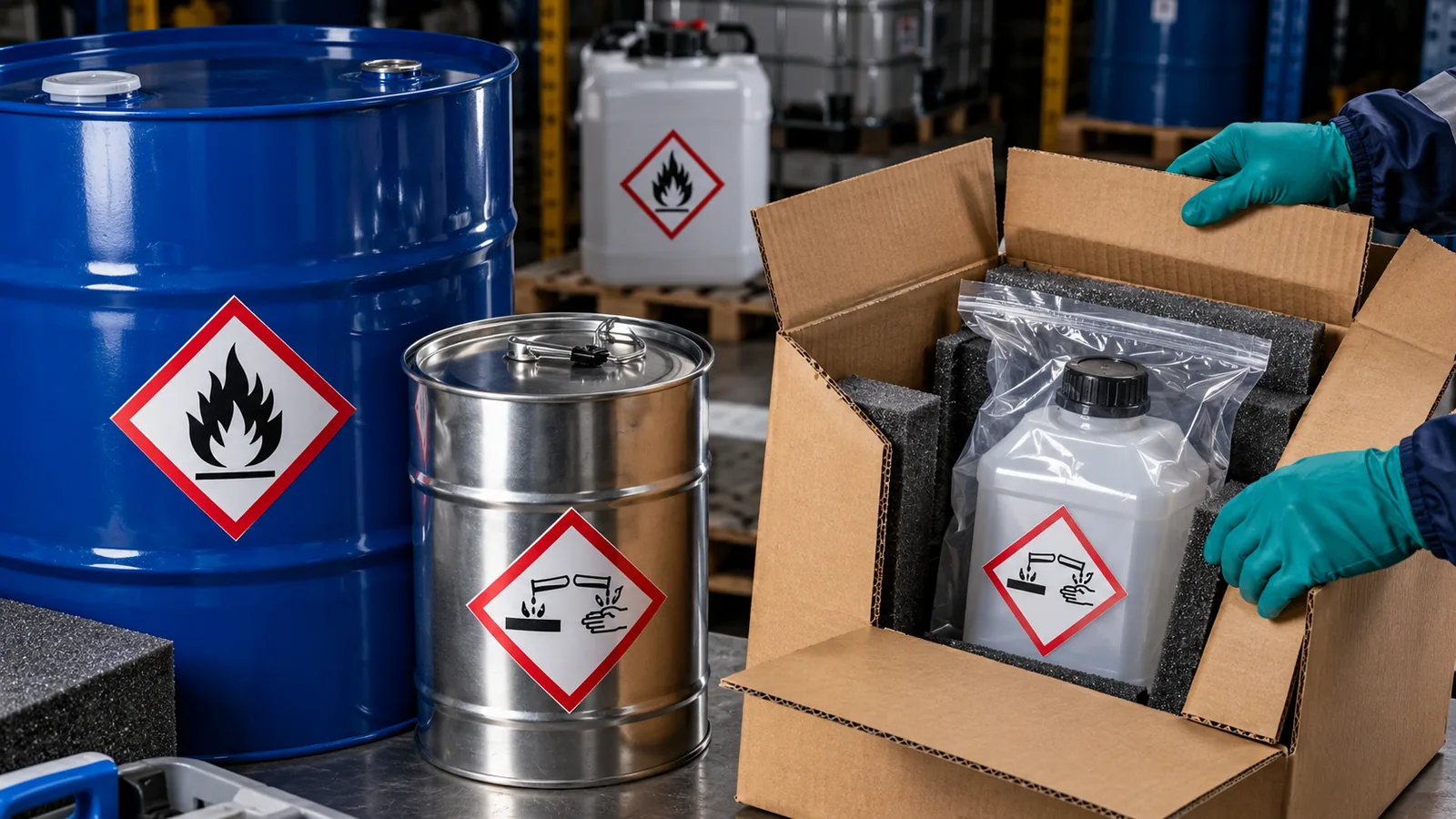
A replacement drum has the same capacity. A revised pail looks identical. A smaller box holds the same bottles.
That does not necessarily mean the existing packaging documentation covers the change.
For hazardous materials packaging, the question is not simply whether a replacement looks or performs similarly. It is whether the packaging matches a qualified design or meets the conditions of an applicable permitted variation.
For procurement, operations, and shipping teams, understanding that distinction can help identify which changes need technical review before the next shipment.
This article focuses on U.S. requirements for non-bulk UN specification packaging under 49 CFR Part 178, Subpart M. Other packaging categories and transportation requirements may involve different provisions.
What a UN Packaging Marking Tells You
A UN packaging marking identifies a packaging type and its applicable performance qualifications. It should be read alongside the documentation describing the packaging design and how it must be assembled and closed.
Under 49 CFR 178.601, manufacturers must successfully complete design qualification testing at the start of production of each new or different packaging. Applicable testing depends on the packaging and its intended use.
For buyers, the practical point is straightforward: a familiar marking or matching nominal capacity is not a substitute for confirming the replacement packaging’s design and applicable instructions.
Five Packaging Changes That Need Review
The regulation identifies five attributes that can make packaging different from a previously produced design. These are review triggers, not a statement that every variation automatically requires a complete new test program. Exceptions and selective testing provisions may apply.
These examples illustrate the five regulatory attributes. Whether a particular change requires testing depends on the packaging type and applicable provisions.
1. Structural Design
A change to a packaging’s structure may affect whether it remains the qualified design.
Before substituting a different configuration, confirm whether it is covered by the existing qualification or requires additional testing. Closure-related changes also deserve attention because the regulations include specific qualifying-test provisions for certain replacement closures and gaskets.
2. Size
A change in size does not always require new testing, but the conditions matter.
For certain packagings other than combination packagings, external dimensions may be reduced by up to 25% without further testing if equivalent performance is maintained and the packaging is otherwise identical, including wall thickness. The marked gross mass, when required, must be reduced in proportion to the reduction in volume.
Combination packagings have separate provisions governing changes to inner and outer packagings. A smaller package should not be assumed compliant simply because it contains less material.
3. Material of Construction
Changes to specified construction materials should be checked against the qualified design.
The regulation includes limited exceptions for certain plastic additives and specific provisions for qualifying steel drums. A material substitution therefore needs a packaging-specific assessment rather than a general assumption that it is either always acceptable or always prohibited.
4. Wall Thickness
Lightweighting and gauge reduction can change a packaging’s specified wall thickness.
Wall thickness is expressly included in the definition of a different packaging. However, certain qualifying steel drums have additional provisions that distinguish between decreases in thickness and limited increases.
Before approving a revised specification, ask the manufacturer whether the change remains covered by the qualified design or requires testing.
5. Manner of Construction
Two containers can share the same capacity and general appearance while being manufactured differently.
Changes to seaming, welding, forming, or assembly may affect design qualification. For certain steel drums, the regulation specifically identifies side-seam welding and end-seam type among the elements used to distinguish drum designs.
When re-sourcing packaging, compare the documented construction specifications, not only the dimensions and price.
Changes That May Be Permitted Without Additional Testing
The regulations provide several exceptions and permitted variations. Each must be evaluated against its specific conditions.
Surface Treatment Only
Packaging that differs only in surface treatment is excluded from the definition of a different packaging under § 178.601(c)(4). However, where an internal treatment or coating is required for safety, the manufacturer must ensure it retains its protective properties after the prescribed tests.
This exception should not be treated as permission to disregard the function of a protective lining or coating.
Smaller or Fewer Inner Packagings
Certain changes to the inner packagings of a tested combination packaging are permitted without further testing under Variation 1.
For substitute inner packagings of equivalent or smaller size, the conditions address:
- Similar design.
- Equal or greater resistance to impact and stacking forces.
- The same or smaller openings and similar closure design.
- Adequate cushioning.
- The same orientation within the outer packaging.
- A package gross mass that does not exceed the tested gross mass.
The equivalent-performance determination must also be documented as required. Fewer inner packagings may be permitted when the applicable conditions, including cushioning requirements, are met.
Reduced External Dimensions
For non-combination packagings, the up-to-25% dimensional reduction provision requires equivalent performance and an otherwise identical design, including wall thickness. It also requires a proportional reduction in marked gross mass when that marking is required.
Separate conditions apply to reduced outer dimensions of combination packagings.
These are examples, not a complete list of the available exceptions and variations.
Manufacturers Must Periodically Retest Packaging Designs
Design qualification is not the manufacturer’s only testing obligation.
Under § 178.601(e), manufacturers must achieve successful periodic retest results at intervals sufficient to verify continued packaging performance, with the following minimum frequencies:
These are manufacturer retesting requirements, not automatic expiration dates for individual unused packages. PHMSA has clarified that unused UN-certified packaging may remain in inventory and later be used without the shipper performing periodic retesting.
For buyers, the useful question is whether the packaging supplied was manufactured under the applicable qualified design and testing program, not simply whether a report is more than 12 or 24 months old.
What to Confirm Before Changing Packaging
Request the Relevant Test Report
A test report must be prepared after each design qualification test and periodic retest. It must be made available to a packaging user or DOT representative upon request.
Ask for documentation that identifies the packaging you will actually receive, including its manufacturer, design description, dimensions, materials, closures, and applicable test results. These are among the required report elements.
Obtain Assembly and Closure Instructions
Test documentation is only part of the picture.
Manufacturers and subsequent distributors must provide applicable information needed to assemble and close the packaging correctly. Shippers performing these functions must follow the applicable instructions.
A replacement container should not automatically be assembled using the previous supplier’s instructions.
Ask These Five Questions
- Does the proposed packaging match an existing qualified design?
- Have its structural design, size, material, specified wall thickness, or manner of construction changed?
- If a permitted variation is being used, which provision applies and what documentation supports it?
- Which design qualification and periodic retest reports cover this packaging and its production?
- What assembly and closure instructions apply to the packaging we will receive?
These questions translate the design qualification, selective testing, reporting, and shipper-responsibility requirements into a practical supplier review.
Keep the Documentation Connected to the Specification
As a procurement practice, keep relevant report references and supplier confirmations alongside your approved packaging specification.
Separately, follow the applicable regulatory requirements for retaining manufacturer notifications, closure instructions, and any selective-testing documentation for which your organization is responsible.
How HAZPlus Supports Packaging Changes
HAZPlus, a division of C.L. Smith within Novvia Group, provides hazardous materials packaging solutions supported by in-house UN/ISTA package testing, certification, compliance guidance, and packing instructions.
For a packaging-change review, prepare:
- The material being shipped and its classification.
- The current packaging specification and full UN marking.
- The proposed change.
- Available test documentation.
- Current assembly and closure instructions.
- Intended transportation modes and shipping conditions.
Providing this information gives the technical team a clearer starting point for assessing the proposed packaging.
Review Changes Before the Next Shipment
A packaging substitution can affect more than purchasing and inventory.
Before approving a new supplier, revised gauge, different material, or changed dimension, confirm whether the packaging is covered by a qualified design or an applicable permitted variation. Obtain the relevant documentation and verify the assembly and closure instructions.
Novvia Group’s packaging specialists can help discuss packaging options and application requirements. Contact a packaging expert with your current specification and proposed change.
Note: This article provides general information about selected U.S. hazardous materials packaging requirements. Requirements vary by packaging, contents, transportation mode, and other factors. Have a qualified hazardous materials professional review the specific application before implementing a packaging change.
Frequently Asked Questions
Does UN packaging certification expire every 12 or 24 months?
Not in the way that wording suggests. Those intervals apply to manufacturer periodic retesting for the packaging categories discussed above. PHMSA has clarified that unused UN-certified packaging does not require shipper retesting simply because it has remained in inventory beyond a periodic retest date.
Does changing suppliers automatically require new testing?
Not necessarily. The replacement packaging may already be covered by its own qualified design and testing program. Confirm the documentation and instructions for the replacement rather than assuming the previous supplier’s records apply.
Can I use a smaller version of packaging that has already been tested?
Sometimes. Applicable provisions permit certain dimensional reductions and changes to combination packagings, but their conditions must be met. Smaller size alone does not establish compliance.
Does a wall-thickness change require retesting?
It may. Wall thickness is one of the attributes used to define a different packaging, but packaging-specific exceptions and provisions must be considered. Any proposed change to specified thickness should be reviewed before implementation.
Can I request the packaging test report?
Yes. Under § 178.601(l)(2), the report must be made available to a packaging user or DOT representative upon request.
What if only the surface treatment changes?
A surface-treatment-only difference is excluded from the definition of a different packaging. However, protective treatments and coatings required for safety remain subject to applicable performance requirements.